It always starts with one job
job run_agent_task(task):
  workspace = clone_repo(task.repo)           # 3 minutes
  image     = build_image(workspace)          # 30 minutes
  result    = run_agent(image, task.prompt)   # 2 hours
  run_tests(result)                           # 20 minutes
  open_pull_request(result)                   # 2 seconds, flaky
The last call returns a 502. Retry the job: 3 hours, gone.
Too long for a request. Too flaky to run once. Too expensive to run twice.
From a Rust system at work that runs AI agent workflows. All code here is pseudocode.
So we split it
job build(task):
  task.image  = build_image(task.workspace)
  task.status = "built"
  enqueue run_agent(task)

job run_tests(task):
  for shard in task.shards:
    enqueue run_shard(task, shard)
  task.status = "testing"

job run_shard(task, shard):
  run_tests_for(task, shard)
  task.shards_done += 1
  if task.shards_done == task.shards.size:   # two finish at once?
    enqueue open_pull_request(task)
Where does the process live?
Nowhere. It is smeared across six files, a column and a cron.
Questions your job queue can't answer
- Which step is task 123 on?
- What did step 2 return?
- How do I wait three days for a human, then time out?
- If I cancel now, what must be undone?
Temporal isn't magic here either: its UI shows what ran, not what comes next. To show your users, you write queries.
Other tools exist
| Idea | Examples |
|---|---|
| Queues with batches | Sidekiq Pro, GoodJob, Solid Queue |
| Resumable steps in a job | ActiveJob::Continuable, chrono_forge |
| Process managers | Rails Event Store |
| Durable execution engines | Restate, DBOS, Inngest, Hatchet |
I haven't researched or verified these. Just pointers.
Act 2
What if the process
was just a method?
Just a method
class AgentWorkflow < Workflow
  def execute(task)
    workspace = activity :clone_repo,  task.repo, timeout: 5.minutes
    image     = activity :build_image, workspace, timeout: 1.hour
    result    = activity :run_agent,   image,     timeout: 3.hours
    pr        = activity :open_pull_request, result

    sleep 3.days                  # really
    activity :ping_reviewers, pr unless activity(:merged?, pr)
  end
end
A worker can die on any line. This still finishes.
Two kinds of code
Workflow
Decides what happens next
- Must be deterministic
- No IO, no clock, no random
- Re-run many times
Activity
Touches the world
- Just your code
- API calls, DB, LLM, files
- Retried, at-least-once
Activities are how you hook in. Everything real is an activity.
Who talks to whom
Temporal never runs your code. Your workers poll it.
First run: every step is written down
dir = activity :clone_repo
img = activity :build_image
res = activity :run_agent
- Scheduled clone_repo
- Completed clone_repo → "/work/42"
- Scheduled build_image
- Completed build_image → "img:9f3"
- Scheduled run_agent
- 💥 workflow worker killed by a deploy
New worker: run the method from the top
dir = activity :clone_repo
img = activity :build_image
res = activity :run_agent
- clone_repo: in the log → return "/work/42"
- build_image: in the log → return "img:9f3"
- run_agent: scheduled, no result → wait
Same code, same inputs, same decisions. Nothing was cloned or built again.
“The system functions via event sourcing: an append-only history of events is stored for each workflow execution, and all required workflow state can be recreated at any time by replaying this history.”
temporalio/temporal, docs/architecture/README.md
You already know these words
| Event sourcing | Temporal |
|---|---|
| Stream | Workflow execution history |
| Command → Event | Command → Event (literally) |
| Rebuild the aggregate | Replay |
| Snapshot | Sticky worker cache |
| Read model | Query |
| Process manager | Workflow |
One big difference: these events are about execution, not your domain.
The same process, two ways
# Process manager
class AgentProcess
  subscribes_to ImageBuilt, AgentFinished

  def apply(event)
    case event
    when ImageBuilt    then @image  = event.image
    when AgentFinished then @result = event.result
    end
  end

  def act
    return open_pr(@result) if @result
    run_agent(@image) if @image
  end
end
# Workflow
class AgentWorkflow < Workflow
  def execute(task)
    image  = activity :build_image, task
    result = activity :run_agent, image
    activity :open_pr, result
  end
end


# apply/act is still there.
# The language runtime wrote it:
# the stack frame IS the state.
It feels a bit like Haskell
add :: Int -> Int -> Intsave :: Row -> IO ()- Haskell: IO changes your type signature, and you can't hide it
- Temporal: IO changes where your code lives. It must become an activity, on a worker
- Either way, it reshapes your design. Workflow code is logic only
And in Ruby? TracePoint.
class BadWorkflow < Workflow
  def execute
    Time.now
  end
end
Cannot access Time now from inside a workflow,
reason: Invalid Time.now call.
- A TracePoint on the workflow thread catches illegal calls
- A deterministic Fiber::Scheduler runs your coroutines
- Zeitwerk autoloading trips it in dev:
Cannot access File path
I haven't used Temporal in Ruby. This is from the SDK docs and a small test.
Act 3
Now the fun part:
patterns are just code
Prebuild N images, at most 3 at a time
queue = images.dup

lanes = 3.times.map do
  async do
    while (image = queue.shift)
      activity :build_docker_image, image
    end
  end
end

all_of(lanes).wait
An array. No Redis, no semaphore, no lock.
The 3 is now part of your history. Change it to 5 and old runs stop replaying.
React to whichever comes first
fast    = async { activity :cheap_model, prompt }
slow    = async { activity :smart_model, prompt }
timeout = async { sleep 10.minutes; :timed_out }

case first_of(fast, slow, timeout).result
when :timed_out then activity :notify_oncall
else                 activity :save, _1
end
cancel_the_others
The timer is durable. The race survives a deploy.
HITL: human in the loop
class Approval < Workflow
  update def answer(value) = @answer = value
  query  def status        = @answer ? :answered : :waiting

  def execute
    wait_until(timeout: 7.days) { @answer }
    activity(@answer ? :deploy : :escalate)
  end
end
No polling, no cron, no column. Seven days cost nothing.
Errors: classify at the source
| What happened | Decision |
|---|---|
| Timeout, 503, rate limit | Retry |
| Bad URL, invalid card | Non-retryable: stop now |
| The record is gone | Success: nothing left to do |
| Task ran, and the answer is “no” | A result, not an error |
raise RetryLater.new("rate limited", type: "RateLimited", retry_in: 90.seconds)
Retry defaults will surprise you
- Default: retry forever. Fine if the activity is idempotent
- “3 attempts” can be 3 seconds. Waits are 1s, then 2s. The provider is down for 20 minutes. You gave up
- Failed attempts leave things behind. Half a build, a dirty folder
- Two kinds of retry. Temporal repeats the activity, or your workflow starts over differently
Poll for results
Submit work to another system. Check once a minute until it's done.
build_id = activity :submit_build, image

def check_build(build_id)           # activity
  raise NotDoneYet unless build_service.status(build_id) == :done
end

activity :check_build, build_id,
  retry: { interval: 1.minute, backoff: 1.0, max_attempts: :unlimited },
  schedule_to_close: 45.minutes     # the real deadline
The retry policy is the wait.
Why fail on purpose?
Loop in the workflow
≈ 11 events
per look: activity, timer, two workflow tasks
45 looks ≈ 495 events
Retries
3 events
Scheduled, Started, Completed, for all attempts together
Retries never land in history
It's Temporal's documented pattern for infrequent polling. The cost: a healthy wait looks like a failing activity.
Sometimes it's just a job queue
class SendEmail < Workflow
  def execute(id) = activity :send_email, id
end

start SendEmail, id: "send-email:#{order_id}", if_running: :use_existing
One workflow, one activity. The id gives you deduplication.
We use Temporal as our background job server.
Schedules: cron that knows what's running
schedule :refresh_images, every: 1.hour, overlap: :buffer_one
| Previous run still going? | Overlap policy |
|---|---|
| Drop this tick | Skip (default) |
| Keep one waiting, drop the rest | BufferOne |
| Queue them all | BufferAll |
| Stop it and start this one | CancelOther, TerminateOther |
| Run both | AllowAll |
Testing: fake the activities
- Logic pulled out of the workflow, i.e. dynamic workflow interpreter
- Activities faked
- Fast, hundreds of cases
- Real: the workflow and activities, their logic, error mapping, values, timeouts
- Fake: the external API client
- When the result can't show how it ran
- Duplicates: 2nd update accepted?
- Races: in-flight activity cancelled?
- Retries: which retry policy?
- All in, all layers
- Docker images, k8s pods, networking, Temporal, authn & authz, and more
- The failures no other test can catch
- Slow as hell
Sleeps in tests? Make durations an input.
My favourite determinism test
Worker.new(max_cached_workflows: 0)
- No cache: every task replays from the top
- If it completes, it replayed
- Completing is the assertion
Rolling a deploy empties the cache anyway. I want that path to be the only path.
Act 4
The bill
Changing a workflow
Code changes. History doesn't. A run in flight must replay on your new code.
Before
activity :build_report
activity :email_report
After
activity :notify_started
activity :build_report
activity :email_report
NondeterminismError: [TMPRL1100] Nondeterminism error:
Activity type of scheduled event 'build_report' does not
match activity type of activity command 'notify_started'
- Your tests won't catch it: they run only the new code, never old history against it
- A run lasts a day, a week, a month? Both versions must work that long
So every change gets a patch
if patched?("notify-started")
  activity :notify_started
end
activity :build_report
activity :email_report
- New runs record a marker. Old runs skip the branch
- The string is a forever contract. We pin it with a test
- Replay histories dumped from Temporal in tests, to check old runs still work. Not tried yet
Patches pile up. Removing one: three deploys
1. Old runs still alive
if patched?("notify-started")
  activity :notify_started
end
activity :build_report
activity :email_report
2. Old runs all finished
deprecate_patch("notify-started")
activity :notify_started
activity :build_report
activity :email_report
3. Runs from step 1 finished
activity :notify_started
activity :build_report
activity :email_report
- Between deploys: wait until the runs started on the previous version are gone
- Runs last a month? Two months to clean up one
if
Or: no patches at all?
- Worker Versioning (GA in 2026). We don't use it
- Every deploy of workers is a version: v41, v42…
- Every run remembers the version it started on
- Pinned: the run stays on its version until the end
- No patches
- Old workers live until their last run ends
- Week-long runs? A week of v41 next to v42, v43, v44…
- Rainbow deploys: every version, at once, in production
- Auto-upgrade: the run moves to the newest workers
- Old workers can go away
- New code replays old history, so patches are back
Stop! How do you stop this?
| Cancel | Terminate | |
|---|---|---|
| Workflow code runs? | Yes, if it listens | Never |
| Cleanup possible? | If you wrote it | No |
| Running activity stops? | Only if it heartbeats | No |
An activity learns about cancel only from a heartbeat reply.
An agent turn that runs for 2 hours? It finds out in 2 hours.
Async activity
- A worker restarts during a deploy? The activity runs again
- Short activity: no pain
- Long activity: more pain. Split it into smaller chunks, so less is retried
- Our agent turn
- Can take long, and you don't know how long: it depends on the prompt
- Runs somewhere else: the worker starts a K8s pod, the agent works there
- Can't be split
- The pattern: the activity starts the work and says "I'll complete later"
- When the agent is done, it tells Temporal the activity is complete
A word from the sponsor of rock-solid workflows
The Rust SDK
Same Update. Two answers.
class Approval < Workflow
  def execute
    @dm = activity :post_slack_dm    # where the question is
    wait_until { @answer }
  end

  update def answer(value)
    @answer = value
    @dm                              # so we can edit that message
  end
end
Cached worker
answer returns the DM. We edit it
Replay from zero
answer returns nil. The DM never changes
No error, no warning. The one thing you were promised can't happen.
The fix
class Approval < Workflow
  def execute
    @dm = activity :post_slack_dm
    sleep 0.001                      # a timer is a command. sdk-rust#1606
    wait_until { @answer }
  end

  update def answer(value)
    @answer = value
    @dm
  end
end
The step after the activity is no longer empty, so the SDK doesn't merge it on replay.
A 1 ms sleep holding up a durable execution platform.
And now it's in the histories. Removing it needs a patch.
Query says yes. Update says no.
Same workflow, same moment. Two different states.
sdk-rust#1623. In our tests: 3 runs in 8. A human is too slow to hit the gap. Automation isn't.
“The current chunker is complex, brittle, and has already introduced non-determinism.”
Temporal's own PR, temporalio/sdk-rust #1659
Fair play: we're on a pre-1.0 pin from June, 224 commits behind. The SDK has since gone 1.0. It's still open.
Mentally taxing: three goals, four problems
| Zero-downtime | Backwards compatibility | Idempotency | |
|---|---|---|---|
| Workflow code | replayed after every restart | new code, old histories: patches | – |
| Activity code | killed mid-run by a deploy | retried: new code, old arguments | runs at least once |
| Input/activity/update payloads | – | old JSON for the retention period | – |
| Timeouts | must outlast a restart | – | a timeout means a retry |
Every small change: check all twelve cells.
Hoops for trivial things
# I want to write one row.
class RecordRunStart < Activity
  def execute(run_id) = db.update(run_id, started_at: now)
end

activity :record_run_start, run_id,
  timeout: 30.seconds, retry: { max_attempts: 5 } if patched?("record-run-start")
One UPDATE: an activity, a timeout, a retry policy, a patch.
Act 5
Now let users write
their own workflows
What we needed
- Users and LLMs submit a workflow. No deploy
- Draw it before it runs
- Show which step we're on
- Show what values each step computed
Attempt 1: embed a JS engine
const files = await session.run("count files")
const doubled = await session.run(`double ${files}`)
It worked. Survived crashes, restarts, replay, cache off.
“Where are we?”
const bugs = (await listIssues(repo)).filter(i => i.labels.includes("bug"))
for (const bug of bugs) {                 // which bug?
  let attempt = 0                         // which attempt?
  let verdict
  do {
    await fix(bug, ++attempt)
    verdict = await review(bug)           // what did the review say?
  } while (!verdict.ok)
}
What would a query even query?
An embedded engine can run the JS. It can't tell you what it is running.
The answers live in VM stack frames. You'd be building a debugger. We never built one.
Flip it: the workflow is data
{ "steps": [
  { "name": "list", "call": "list_issues", "args": { "repo": "input.repo" } },

  { "map": { "in": "steps.list.output.filter(i, 'bug' in i.labels)", "as": "bug",
    "body": [
      { "doWhile": { "cond": "!steps.review.output.ok", "body": [
          { "name": "fix",    "call": "fix",    "args": { "issue": "bug" } },
          { "name": "review", "call": "review", "args": { "issue": "bug" } } ] } }
    ] } }
] }
Structure: JSON. Leaves: CEL.
The interpreter is one workflow
class InterpreterWorkflow < Workflow
  query def progress = @progress

  def execute(plan, input) = walk(plan.steps, Env.new(input))

  def walk(steps, env)
    steps.each do |step|
      case step
      when Call
        args = Cel.eval(step.args, env)   # right here, in the workflow
        @progress[step.path] = :running
        env.steps[step.name] = activity(step.op, args)
        @progress[step.path] = :done
      when If then walk(Cel.eval(step.cond, env) ? step.then : [], env)
      end
    end
  end
end
Why CEL fits a workflow
steps.list.output.filter(i, 'bug' in i.labels)- Common Expression Language, from Google. No IO, no clock, no mutation
- Can't break replay. There's no
Date.nowto call - Runs in Kubernetes admission, Cloud IAM, Envoy, Firebase rules
- LLMs know it, and parse errors teach them
- Seven implementations: Go, C++, Java from Google. Rust, Python, JS/TS, Ruby from the community
Now the query just works
7 issues, 4 bugsreview ok after 1 attemptreview ok after 2 attemptslast review: "tests fail"Step identity = path + loop iteration. Rebuilt by replay, for free.
How hard is it to show?
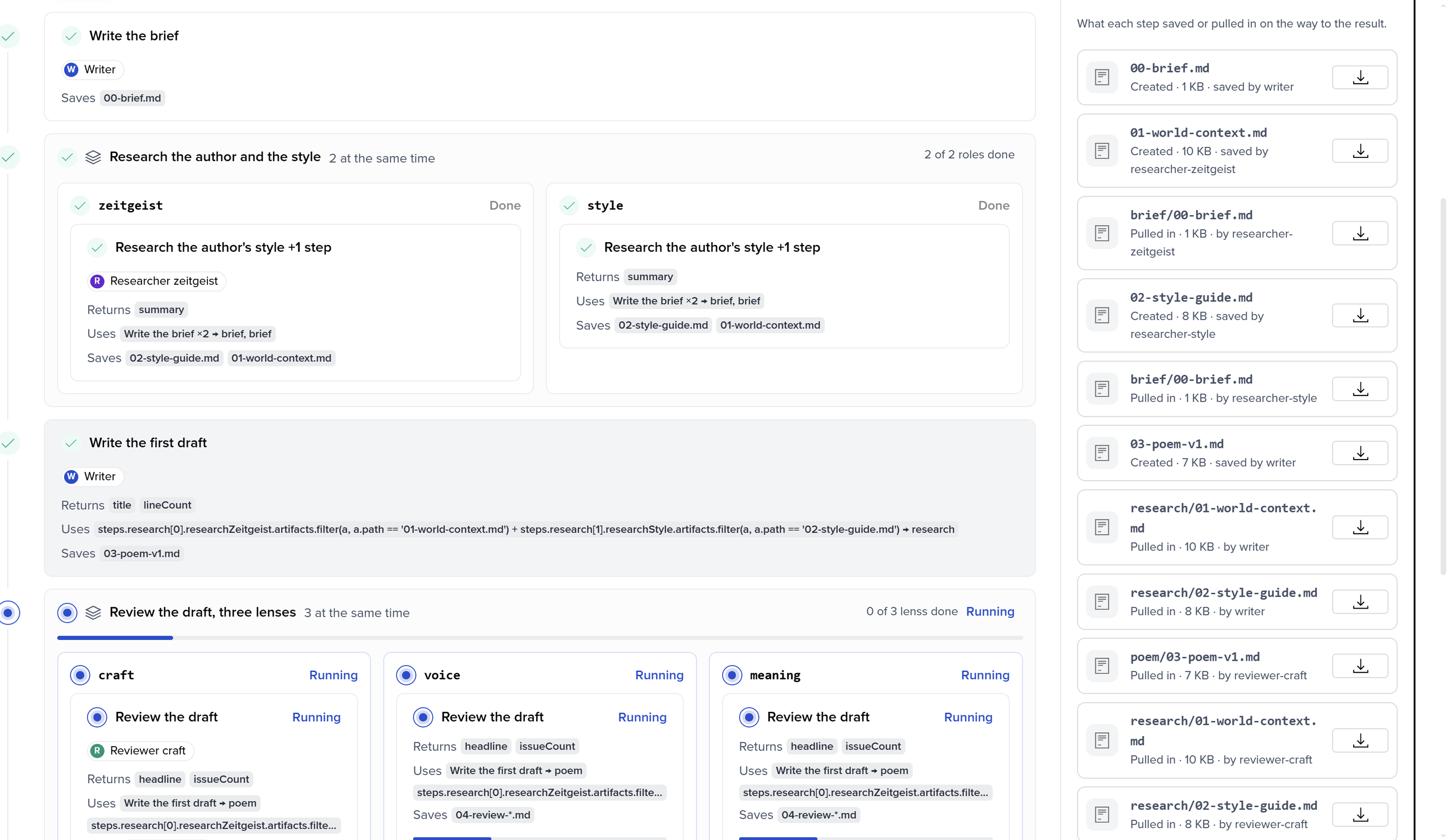
Promise.all, race, any, allSettled, for await, AbortController, fire-and-forget, a semaphore… Each needs its own syntax and its own pictureOur DSL stops at parallel map. Every step up needs a new picture.
What it looks like
Still not free
- Non-Turing-complete ≠ bounded: a few hundred bytes of nested
.all(), tens of seconds - “Pure” can still vary: a hash map had to get sorted keys
- Bad reference? Not a parse error. Fails at run time
- User text is an attack surface, and it runs in your worker
No conclusion.
Just what stayed with me.
pankowecki.pl · github.com/paneq
A different way of thinking
- The log is the truth. The running code is a projection of it
- Log-based truth, reached from the problem, not the pattern
- Time is just another thing that happens
- Crash stops being a special case
Appendix
Real Ruby, for the questions
gem temporalio 1.10.1, on the SDK test server. Not something I use at work
Workflow, activity, retries
class Charge < Temporalio::Activity::Definition
  def execute(amount)
    raise Temporalio::Error::ApplicationError.new(
      'card declined', type: 'CardDeclined', non_retryable: true) if amount < 0
    "charged #{amount}"
  end
end

class ChargeWorkflow < Temporalio::Workflow::Definition
  def execute(amount)
    Temporalio::Workflow.execute_activity(Charge, amount,
      start_to_close_timeout: 30,
      retry_policy: Temporalio::RetryPolicy.new(
        initial_interval: 1, backoff_coefficient: 2.0, max_interval: 60,
        max_attempts: 5, non_retryable_error_types: ['InvalidCard']))
  end
end
Bounded parallelism, race
W = Temporalio::Workflow

slots = W::SizedQueue.new(limit)
futures = items.map do |item|
  W::Future.new do
    slots.push(true)
    begin
      W.execute_activity(Work, item, start_to_close_timeout: 30)
    ensure
      slots.pop
    end
  end
end
W::Future.all_of(*futures).wait

cancellation, cancel = Temporalio::Cancellation.new(W.cancellation)
act   = W::Future.new { W.execute_activity(Work, 1, start_to_close_timeout: 30, cancellation:) }
timer = W::Future.new { W.sleep(3600, cancellation:); :timeout }
W::Future.any_of(act, timer).wait
cancel.call
Cancel with cleanup, test a week
def execute
  W.sleep(3600)
rescue Temporalio::Error => e
  raise unless Temporalio::Error.canceled?(e)
  W.execute_activity(Cleanup, start_to_close_timeout: 30,
                     cancellation: Temporalio::Cancellation.new) # detached
  raise
end

Temporalio::Testing::WorkflowEnvironment.start_time_skipping do |env|
  # a workflow sleeping for a day finishes right away
end

require 'temporalio/worker/workflow_replayer'
Temporalio::Worker::WorkflowReplayer.new(workflows: [MyWorkflow])
  .replay_workflow(handle.fetch_history)
Limits to remember
| Limit | Warns | Fails |
|---|---|---|
| History events | 10,240 | 51,200 |
| History size | 10 MB | 50 MB |
| Single payload | 512 KB | 2 MB |
| Pending activities or children | 2,000 |
Polling guide: under 1s, loop in an activity and heartbeat. Over 1 min, use retries. Complex: child workflow and Continue-As-New.
Reading list
- Temporal Ruby: crash-proof fibers, Chad Retz
- Demystifying Determinism in Durable Execution, Jack Vanlightly
- Polling External Services, Temporal docs
- Migrating from Temporal to Postgres, Nango
- Absurd Workflows, Armin Ronacher
- sdk-rust #1623, #1629, #1659
- cel-spec, cel-ruby, CEL in Hatchet